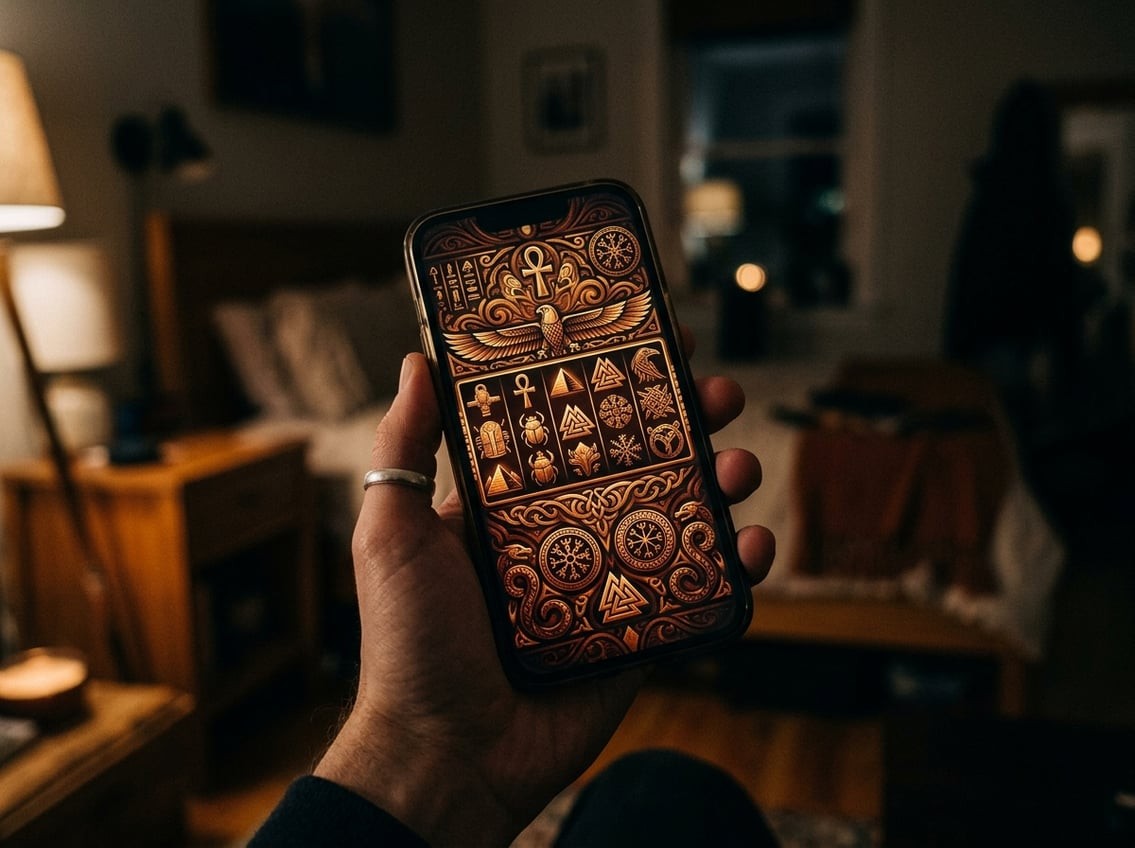
You could spend a career studying what themes work in pokies design without ever settling the question. The catalogue of Australian PayID casinos runs to several thousand games across dozens of studios, and the same thematic buckets keep filling and emptying and filling again. A studio releases an Egypt-themed pokies. It does well. A year later, another studio releases a different Egypt-themed pokies. It does well. Ten years pass; nothing has changed except which studios are dominant. This is a feature about what those buckets are, why the same ones keep returning, and what a player is actually choosing when they select one from the lobby at a PayID-accepting operator.
The head keyword here is payid pokies, which I've now used, so let me get on with the actual read.
Ancient Egypt, the immortal
Egypt is the theme that will outlive every other. Book of Ra Deluxe, Book of Dead, Legacy of Dead, Rise of Ra, Cleopatra — the naming variations run into three digits, and the mechanic is often the same: a "book" symbol that triggers a bonus round with an expanding special symbol. The theme's persistence is not accidental. Egypt supplies visual vocabulary — gold, sarcophagi, hieroglyphs, pyramid geometry — that maps naturally onto the visual language of a pokies game. It also supplies "adventure" without violence, "history" without political entanglement, and "mystery" without complexity. The template is unusually flexible.
What a player is choosing when they pick an Egypt-themed game, in the catalogue as it exists at PayID casinos today, is typically a Play'n GO game (Book of Dead is theirs), a Novomatic game (Book of Ra), or one of the many derivative studios that have built their own variants. The volatility on these games skews high — you can grind through your bankroll waiting for a bonus round that either transforms the session or fails to arrive.
Why the "book" mechanic keeps returning
The book-scatter mechanic — a single expanding symbol chosen at random for the bonus round, with retrigger potential — is one of the most enduring designs in pokies. Its persistence comes from the way it produces both mid-session dry spells and occasional session-defining hits, which corresponds to the emotional shape most players are looking for whether they'd articulate it that way or not. Studios that build their Egypt-themed products around this mechanic are, in effect, iterating on a proven template.
Norse mythology, the reliable
Vikings and Norse gods entered the catalogue in strength around 2018 and have not left. NetEnt's Vikings series set the initial mould; Yggdrasil, Push Gaming, Nolimit City, and half a dozen smaller studios have released their own takes since. The theme supplies visual grimness — ravens, longships, storms — that appeals to players wanting something less bright than an Egypt-themed game. The mechanics on Norse-themed games have tended to introduce more experimental features than the Egypt catalogue does, partly because the theme itself is newer.
A player choosing from the Norse-themed shelf at a PayID casino is likely picking between one of NetEnt's polished mid-volatility games or one of the newer studios' higher-volatility, more mechanically ambitious releases. Both are reasonable choices for different session types. Neither is close to what you'd find on a licensed Australian venue floor.
What Nolimit City did to the sub-genre
Nolimit City's mid-2020s releases in the Norse space — the Punk Rocker franchise, San Quentin xWays, and their broader mechanical repertoire — pushed the sub-genre into territory that felt closer to a video game than a traditional pokies. The volatility profile is extreme, the bonus mechanics are dense and layered, and the sessions are unrecognisable from the NetEnt-era Vikings games. Some players love this; some find it unplayable. It is worth knowing what you're getting into.
Irish folklore and the evergreen leprechaun
Rainbow Riches ran for a decade and a half in British bookmakers before it moved online, and its offspring still populate the Irish-themed shelf. Leprechauns, pots of gold, four-leaf clovers, Guinness-adjacent iconography that no one is bothered by. Barcrest and Blueprint dominate the sub-genre. The mechanics are typically low-to-mid volatility, generous with small wins, and less punishing than the Egypt or Norse catalogue. This is not necessarily a good thing — low volatility often means slower attrition rather than actual reduced risk — but it makes for a session that feels less brutal for casual play.
Every generation gets its own Rainbow Riches. The names change; the leprechaun does not. On enduring themes
Fruit machines, the self-reference
The classic-fruit theme — cherries, bells, sevens, bar symbols — is now a self-referential design choice rather than an actual game mechanic. Modern "fruit" pokies at PayID casinos are almost always Pragmatic Play or Play'n GO releases that use the visual language of 1970s slot machines but layer on modern volatility and modern features. Sweet Bonanza is the archetype: it looks like sweets, plays nothing like an actual mechanical fruit machine, and does numbers that would have been impossible in the era it's referencing.
What a player gets from a fruit-themed pokies at a modern operator is nostalgia layered on top of a contemporary product. The nostalgia is genuine — there is a warmth to the aesthetic — but the underlying game is not the game the aesthetic is invoking. This is not deceptive, exactly; it's just something worth knowing.
Asian mythology and the lantern aesthetic
Chinese, Japanese, and pan-Asian mythology have grown from a small subgenre to something like a quarter of the total catalogue at typical PayID casinos over the last five years. Red, gold, lanterns, dragons, koi, pandas — the visual vocabulary is dense and consistent. The mechanics vary widely: some Asian-themed games are low-volatility casual products; others (Nolimit City's more aggressive releases in particular) are high-volatility grinders that produce shocking sessions in both directions.
The commercial force behind this shelf is not Australian demand but Asian-market demand generally, which is where a lot of the offshore operators concentrate their portfolios. Australian players are seeing the same catalogue as players in Singapore and Malaysia, filtered lightly for local presentation. The theme is dominant globally, and Australia is receiving a lightly-Australianised version of the global product.
The prosperity-cash-collect mechanic
A specific mechanic — variously called "hold and win", "cash collect", or "money respin" — dominates the Asian-themed shelf at most operators. It typically involves red envelopes or lantern symbols that collect cash values, with a bonus round triggered by landing enough of them. Pragmatic Play's Wild Wild Riches, Play'n GO's 3 Clown Monty, and dozens of others use variations of this. The mechanic is popular because it produces frequent small-to-mid-sized wins that keep the session feeling engaged without producing the extreme dry spells of book-style bonus games.
Adventure, exploration, and the modern era
The newest thematic bucket to enter the catalogue in force is what one studio veteran described to me as "modern-adventure" — themes drawn from streaming-era popular culture, indie-game aesthetics, video-game-adjacent visual language. Nolimit City in particular has released a catalogue over the last three years that reads more like a small-run video game series than a traditional pokies catalogue. These games skew younger, more volatile, more mechanically experimental, and appeal to a specific slice of the PayID-casino player base that overlaps with the video-gaming audience rather than the traditional pokies audience.
The Hacksaw and Push Gaming influence
Two studios in particular have expanded the modern-adventure category over 2024 and 2025. Hacksaw Gaming's releases are visually distinctive, mechanically dense, and heavily marketed to a younger cohort of players through streamer-driven promotion. Push Gaming's Razor Shark and its successors sit in the same territory. The influence has been enough to shift what the front page of a typical PayID casino lobby looks like — five years ago it was mostly Egypt and fruit; today it is mostly a rotating mix of the modern-adventure releases from the four or five studios pushing this aesthetic hardest.
What this signals about the audience
The rise of the modern-adventure theme is a legible signal about the changing PayID-pokies demographic. The player who chooses a Hacksaw release over a Novomatic Book of Ra is younger, more digitally native, more likely to have discovered the game through streamer coverage than through a lobby browse, and more likely to be treating the pokies session as adjacent to a video-game session rather than as a continuation of the venue-machine experience. This is not a normative judgement — the games are what they are — but it's a real shift in who the audience is and what they're looking for.
What the theme actually signals
The theme of a pokies game is, in one important sense, decoration. The mathematics of the game — its return-to-player percentage, its volatility profile, its bonus-round hit frequency — is determined by the studio and is largely independent of whether the paint job is Egyptian or Irish. A player choosing by theme is choosing an aesthetic; they are not choosing a different mathematical experience unless they also research the game's specifications.
What the theme does signal, weakly, is the studio behind the game. Certain studios are known for certain themes and certain volatility profiles. If a player knows they like Play'n GO's high-volatility book-style games, choosing an Egypt-themed Play'n GO release will reliably give them that experience. If they know they like Pragmatic Play's mid-volatility sweet-themed releases, choosing accordingly gives them that. The theme is a proxy for the studio, and the studio is a proxy for the game's mathematical character.
Reader questions
Which theme has the highest RTP on average?
There is no strong pattern. RTP is set by the studio at development time and varies within themes more than between them. A well-known Egypt-themed game and a well-known Norse-themed game from the same studio will often share an RTP within a fraction of a per cent. The theme is aesthetic, not mathematical.
Are there any themes I should specifically avoid?
Themes that use imagery of children, that reference active tragedies, or that lean into stereotypes deserving of retirement — a small share of the catalogue, but present. Beyond that, avoid themes that don't suit your session type; a high-volatility session on a Norse game is not the same experience as a low-volatility session on an Irish one.
Do PayID casinos have themes that Australian venue machines don't?
Yes, extensively. The offshore studio catalogue is much broader than what Aristocrat and IGT bring to Australian venues. The trade-off is that offshore games often play differently — higher volatility, faster cycles, more experimental features — than a player accustomed to Aristocrat's house style will expect.
Do the same themes at different studios play differently?
Substantially. Two Egypt-themed pokies from two different studios can have completely different volatility profiles, bonus mechanics, and hit frequencies. The theme is the label; the studio is the recipe. If you like a game, checking its studio is the fastest way to find similar games.
18+ and responsible gambling
18+For Australian adults. Journalism, not endorsement.
Gambling Help Online · 1800 858 858 · Lifeline 13 11 14.