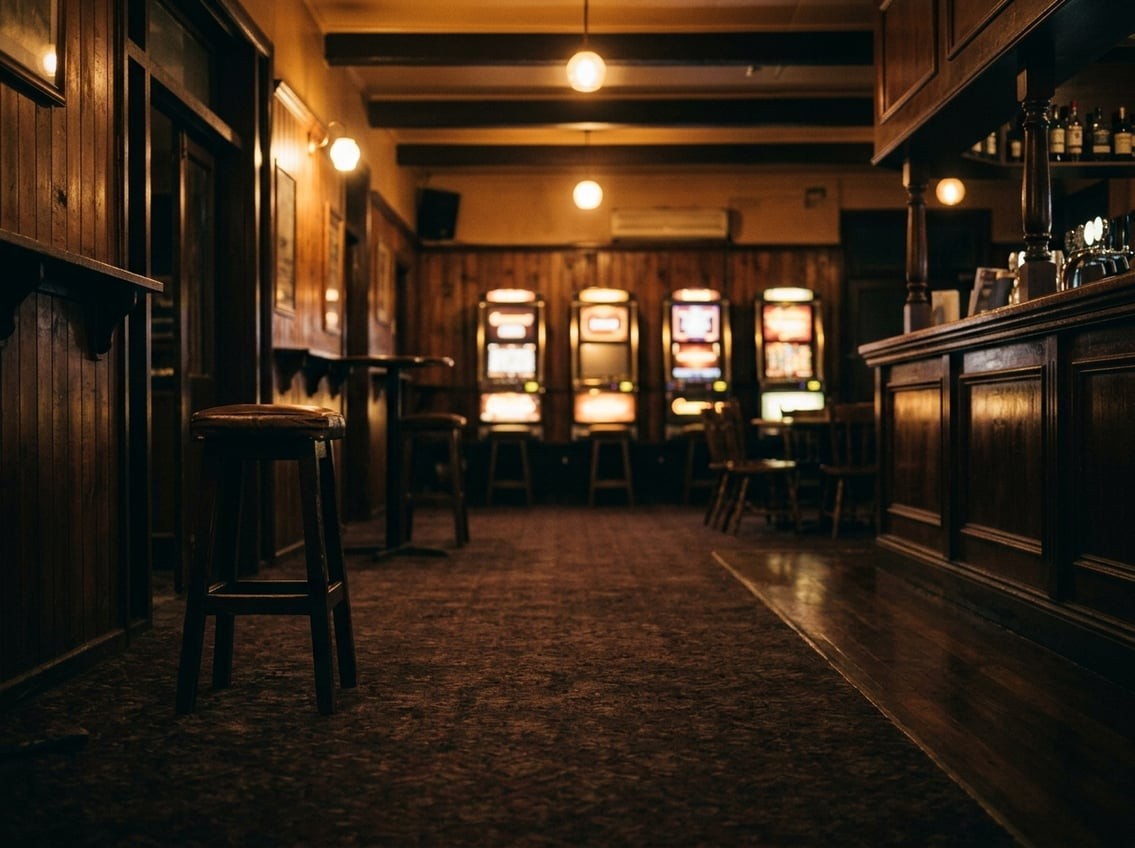
The bloke in the corner of the Cross Keys wasn't playing the pokies in front of him. He was on his phone, and every few minutes he'd tap something and the phone would beep and he'd stare a while and then tap something else. The machine beside him was on but idle, screen cycling through its attract mode, the sound turned all the way down as it is in most public bars after eleven. When I finally worked up the nerve to ask him what he was doing, he showed me. He was playing pokies. Just not those pokies. He'd deposited forty dollars twenty minutes earlier and was watching the reels turn on a game called something like Sweet Bonanza, hosted at an offshore operator, funded through a payment method I only half-understood at the time. He called it "PayID."
That was in October 2024. I'd been asked to write something about the pokies-in-pub culture for a Saturday magazine that no longer exists. What I ended up with, months later, was a much stranger story: how a piece of Australian financial infrastructure — a real-time bank transfer system engineered for utility payments and pay-splitting — had become the default rail for a shadow gambling economy operating alongside, and outside, the licensed venue trade.
This is that story, updated for July 2026. It is not the numbers-first analysis you can find at more clinical publications; the numbers matter, and I'll cite them where they do. It is a feature about the rail and the room and the people using both. The head keyword the search engines want you to arrive at is payid pokies, so let me use it once and get out of its way.
The rail, briefly
PayID is an addressing layer. It sits over the New Payments Platform — the real-time bank transfer system the Reserve Bank helped build and switched on in 2018 — and lets you send money to a phone number, email address, or ABN rather than a BSB and account number. The rail itself is the NPP. PayID just resolves the name to the number for you, checks that the person on the other end is who you think they are, and lets your bank do the transfer.
For most people it's the "$40 dinner split" mechanism. For a subset of people, since roughly the middle of 2024, it's been how they fund their pokies play. The mechanics are the same. The context is entirely different.
The shift from cards
Two things happened at once. First, Australian issuing banks — Commonwealth, Westpac, NAB, ANZ, and most of the smaller institutions — progressively tightened their acceptance of card transactions to gambling merchants through 2023 and 2024. Card declines against offshore pokies operators rose from a modest baseline to something like one in seven attempts by late 2024. Second, offshore operators, watching their conversion rates on card deposits collapse, started integrating PayID as fast as they could.
By early 2025 most of the operators visible to Australian search traffic had a PayID option. By the middle of 2025 it was the default option. By the time I'm writing this, in July 2026, roughly six out of every ten deposit dollars into Australian-facing offshore pokies flow through the rail. Card is still listed at most operators but has become a fallback rather than a first choice.
Two years ago, this was a story about a card being declined. Now it's a story about a rail being embraced. The mechanism is the same — Australians wanted to gamble online, and someone found a way to make it work — but the shape of the mechanism changed the story around it. Nightshift, on the payments layer
An evening at the Cross Keys, revisited
I went back to the Cross Keys in April. The bloke from the corner wasn't there — or wasn't there that evening — but four different versions of him were, at four different machines, all doing roughly the same thing. Phone in hand, occasional glance at the venue machine in front of them, most of the actual play happening on the phone. The venue's own pokies room, which used to hold a couple of dozen serious players at that hour, held six people including me. Two of them were playing the venue machines. The other four were doing something else entirely.
The bar itself was busy. The pool tables were busy. The place had lost none of its texture — the sticky carpet, the amber wall lights, the row of framed local footy photographs from the 1980s that no one under sixty recognises anymore. What had been lost was the specific attention that used to be pointed at the machines. It has diffused, moved elsewhere, split itself between the atmosphere here and the mechanics there. The pub is fine. The relationship between the pub and the pokies is different.
The room that used to be a pub
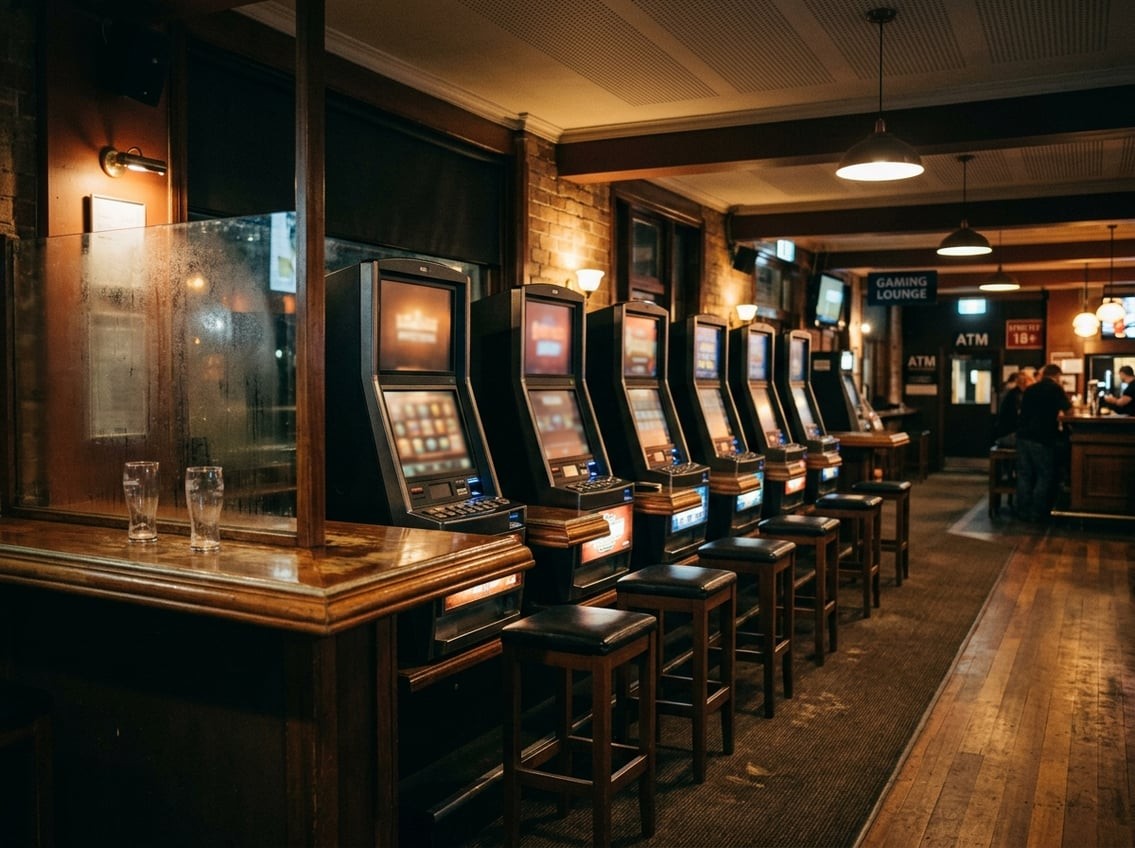
The bloke at the Cross Keys stayed on my mind. Over the following months I spent time in what used to be called the pokies room — the enclosed, low-lit section of a licensed venue where the machines live — watching who came in, how long they stayed, what they were doing. The finding was consistent and, if you spend enough time in these rooms, obvious in retrospect: the room is emptier than it used to be.
Some of the missing players are missing because the industry as a whole has contracted. Some are missing because they've aged out or died. But a fraction — an undercountable but non-trivial fraction — are missing because the room's function has been unbundled. The atmospheric part happens at the pub, in the front bar with a pint. The wagering part happens on a phone, on a rail, in a game hosted three time zones away. The pub still gets the pint money. Someone else gets the deposit.
Who's actually playing
The demographic profile of the PayID-pokies player, as best I've been able to piece it together from operator disclosures, panel data cited in more quantitative publications, and my own conversations, is not what the popular imagination expects. It skews younger than the licensed-venue demographic — median in the mid-thirties rather than the mid-fifties. It skews slightly more male, but the gap is narrower than the venue gap. It skews toward metropolitan and outer-metropolitan rather than regional, which is the opposite of the venue skew.
What is not in the profile: pokies-only players. The overwhelming majority of PayID pokies players do other things too. They sports-bet. They play online table games. They have accounts at licensed Australian wagering operators (Sportsbet, Ladbrokes, PointsBet) alongside their offshore accounts. The offshore-only, pokies-only player is a corner case of the population, not the median case.
Who's actually running this
The operators come in three loose tiers. At the top, a handful of well-capitalised international groups running large brand portfolios out of Malta or the Isle of Man — the sort of firm that has a compliance department, a licensing budget, and enough scale to absorb the cost of running Australian-facing operations properly. In the middle, a much larger group of Curaçao-licensed operators running one to five brands each, competent but variable, some run well and some run poorly. At the bottom, a long tail of small operators that come and go, sometimes exit before paying out balances, and account for most of the horror stories.
Distinguishing the tiers from the outside is harder than it sounds. The polish of the front-end website is not a strong signal — the templates are shared across tiers. The stated licensing is a signal but not a strong one; Curaçao licenses in particular vary enormously in what they actually enforce. The clearest signal available to a non-expert is the operator's history of complaints, the presence and cooperativeness of their support function, and how they handle a small first withdrawal.
The games themselves
The pokies at PayID-accepting operators are not the same pokies that populate Australian venues. Australian venue machines are dominated by Aristocrat and IGT — Big Red, Where's the Gold, Lightning Link, the endless variations. The offshore online catalogue is dominated by a different set of studios: Play'n GO, Pragmatic Play, NetEnt, Yggdrasil, Nolimit City, Push Gaming, Hacksaw. The mechanics overlap but the vibe is different — offshore games are typically higher-volatility, faster-cycling, more animated, with progressive features and mechanics unfamiliar to a venue player.
Some of the Aristocrat back-catalogue is available online through licensing arrangements with operators that hold appropriate rights. This is a small share of the catalogue in most cases and available at only a subset of operators. A player who thinks they can replicate the venue experience at an offshore operator will generally be disappointed. It's a different product with a family resemblance rather than a substitute.
The money, honestly
The commercial model at offshore operators is simple. They set a house edge — usually four to seven per cent on the pokies catalogue, sometimes tighter on specific games as a marketing move — and they take that edge over time. On a busy operator, the aggregate edge over the year is where the profit comes from. The individual player experience is dominated by variance — big wins, big losses, and a general downward drift that most players can articulate if pressed but that few internalise.
Layered over the house edge is the FX cost. Most offshore operators settle in USD or EUR internally, and they convert AUD to their settlement currency at a rate that sits one to four per cent from the interbank mid-market, applied at both deposit and withdrawal. The round-trip is two to eight per cent. This is real money and it is the closest thing to a hidden fee that exists at these operators.
The regulator's view
Three Australian regulators have partial visibility. The Reserve Bank oversees the rail. ASIC handles consumer protection on the payments side. The Australian Communications and Media Authority — the ACMA — is the body with responsibility for the gambling side, under the Interactive Gambling Act 2001. None of them has end-to-end jurisdiction over the transaction chain.
The ACMA's response has been to focus on the operators rather than the players. Blocking orders against offshore sites are issued regularly and enforced at ISP level. Warnings are published. Payment-processor pressure is applied where possible. The ACMA does not, as a policy stance, chase individual Australian residents for playing at offshore operators, and no one has been prosecuted for it. The enforcement model is upstream of the deposit.
The uncomfortable part
Any honest feature about this world has to acknowledge that the rail's speed matters for harm. The academic literature is consistent: reduced friction between "I want to gamble" and "I am now gambling" correlates with increased spend and, in the harm indicators, increased damage. PayID has, unambiguously, reduced that friction relative to card. Whether that translates into a measurable public-health effect at population scale is a question the researchers are still working through, but the direction is not in dispute.
The most useful thing I can say from the reporting is this. If you gamble a lot, the rail's speed is doing you no favours. The bank-level gambling merchant block available in most Australian banking apps is genuinely effective, is one of the few interventions that survives the willpower failures gambling harm depends on, and requires only a couple of taps to enable. It requires a cooling-off period to disable, which is what makes it work. Setting it up when things are not in crisis is worth an evening's inconvenience later.
Support when it's needed
Two Australian services are worth memorising even if you don't currently need them. Gambling Help Online — 1800 858 858 — is free, twenty-four-hour, anonymous, and staffed by people trained to help. Lifeline — 13 11 14 — is the broader crisis line and worth knowing regardless. Neither will lecture. Neither will judge. Both have been used, quietly, by more of the people you know than you would guess.
The BetStop register is Australia's national self-exclusion mechanism. Registration blocks all Australian-licensed operators for the duration you set. Offshore operators are, in principle, expected to honour it, and reputable ones do. The register is available at betstop.gov.au and takes about ten minutes to set up. Whether or not you use it, the fact that it exists — and that it works — is one of the quieter good-news stories in Australian gambling policy.
The rail is not evil. The rail is doing what it was built to do, moving money quickly between parties who consent to move it. What it enables, and how easily, is a different question — one worth sitting with. Nightshift, on friction
The cross-border complication
One thing I hadn't expected to have to reckon with is the cross-border reality of these transactions. Almost every operator serving Australian residents does so from an office in Malta, the Isle of Man, Curaçao, Gibraltar, or Cyprus. The rail moves the money from an Australian bank account to that operator's Australian receiving bank account, but the operator's operational entity — its staff, its systems, its legal seat — sits elsewhere. When something goes wrong, the resolution path travels through jurisdictions the average Australian player has never dealt with.
Some jurisdictions are better than others at this. Malta's regulator has published dispute-resolution processes, timelines, and case volumes that make the system legibly operational. Isle of Man is similar. Curaçao's newer post-2023 licensing framework is meaningfully better than what preceded it but is still finding its feet. For a player who never has a dispute, none of this matters. For a player who does, the jurisdiction of the licensing regulator becomes the single most important characteristic of the operator they chose.
The defaults are the story
If I've learned one thing writing this piece across nearly two years, it's that the interesting story here is not "gambling is bad" or "PayID is bad." It's the defaults. The rail replaced cards not because Australians campaigned for it, but because the payments infrastructure they were already using shifted underneath them. The friction dropped because the plumbing changed, not because anyone made a decision about it. That's how a lot of things happen in the twenty-first century, and it is worth being awake to.
The corollary is that changing defaults changes behaviour. The Reserve Bank and Treasury discussions about default gambling blocks — where the bank-app gambling block would be on by default, requiring an opt-out to disable — would be a real intervention. Not because it would stop anyone determined to gamble, but because defaults matter more than most of us admit. The current default is a rail that takes forty seconds to open the game and eighty-seven seconds to fund it. Change the default, change the shape of the room.
The Nightshift take
Nightshift is a features publication. It is not a review site. I am not going to rank operators or recommend where you should deposit. What I can offer is the frame I've built through this reporting.
PayID as a rail is fast, mostly reliable, and materially cheaper for operators than card, which some of them pass through to players and some don't. The FX cost is the real cost, is understated in most operator disclosures, and is worth reading the payments-methods fine print to understand. The withdrawal times are the operator's, not the rail's, and vary by nearly two orders of magnitude between the best and worst operators. Withdrawal responsiveness is the single best proxy for how much you should trust an operator you're considering.
If you play, play the amount you had decided to play before you tapped deposit, and stop when you've played it. If you find yourself tapping deposit for the third time in a session because the previous two disappeared quickly, that is a signal from the rail that something has changed about the session — either the game is not for you, or the day is not for gambling, or the rail is doing exactly what it is engineered to do and is doing it too well for your good.
What might change next
Three things worth watching, in ascending order of how much they would matter. First, the Reserve Bank and Treasury discussions on default gambling blocks have moved from position paper to draft framework over 2025. If they land as policy, the Australian banking sector will be required to enable the block by default and require an opt-out. This is the single biggest policy lever available and it is closer to becoming real than it was a year ago.
Second, further tightening of card acceptance to gambling merchants will likely push residual card volume to zero over the next twelve to eighteen months. This is not a policy change so much as a continuation of the trend. It matters because it removes the fallback rail — if PayID becomes the only option and the block is enabled by default, the friction question changes materially.
Third, and most speculatively, the possibility of an Australian-licensed online pokies framework has been raised in industry papers throughout 2025. Whether Australia will follow the UK's path — licensed online operators, with domestic regulatory oversight — or maintain the current prohibition remains an open question. The industry is lobbying for the former. Public health voices are, largely, opposed. Where policy lands is not something I would predict.
Reader questions
What is PayID and why has it become the default at Australian pokies sites?
PayID is an addressing layer on top of the New Payments Platform, the Reserve Bank–overseen real-time bank transfer rail that has been in production since 2018. It became the default at Australian-facing offshore pokies operators through 2024 and 2025 because Australian issuing banks progressively tightened card acceptance for gambling transactions, leaving operators looking for an alternative. PayID clears in under two minutes for most transactions, requires no card details, and is familiar to Australian bank customers.
How long do PayID pokies withdrawals actually take, honestly?
The rail-layer time is under two minutes. The operator-side approval queue is where the actual wait sits — typically 45 minutes to 24 hours at the best operators, up to several business days at the worst. The advertised "instant" withdrawal times refer only to the rail once approval is granted, not to the approval itself.
Is depositing to an offshore pokies operator via PayID legal in Australia?
For the individual Australian resident, yes — the Interactive Gambling Act targets operators, not players. The offshore operator may be in breach of Australian law by offering the service, and the ACMA regularly acts to have such sites blocked at Australian ISPs, but no Australian resident has ever been prosecuted for playing at an offshore pokies site.
What happens if a PayID transfer to a pokies operator goes wrong?
Two failure modes. Rail-side failures are self-correcting — the funds either never leave your account or are returned within a day. Operator-side reconciliation failures, where funds arrived but haven't credited, need a support ticket with your transaction reference. Unlike credit card, there is no chargeback mechanism; once the rail settles, the transaction is final.
Are the pokies at PayID-accepting sites the same as the ones in venues?
Sometimes, but usually not. Offshore operators contract with global game studios — Play'n GO, Pragmatic Play, NetEnt, Yggdrasil, dozens of others — whose games are broadly not the same catalogue as Aristocrat or IGT machines in Australian venues. There is some overlap, but the catalogues diverge more than they meet.
How does PayID compare with cryptocurrency for pokies deposits?
PayID is AUD-native, fast, and integrated with Australian banking. Crypto is faster on some chains and slower on others, adds volatility exposure and cross-border complexity, and requires either an existing wallet setup or an exchange purchase step. Most Australian players use PayID; a smaller cohort of crypto-fluent players uses stablecoins.
What are the real costs to a player using PayID at pokies sites?
The rail itself is free. Operators cover their processing costs through FX spread on the AUD-to-settlement-currency conversion, typically one to four per cent applied at both deposit and withdrawal, meaning a round-trip cost of two to eight per cent depending on operator. This is the closest thing to a hidden fee and is worth reading the payments-methods page to understand.
How do I know an operator accepting PayID is trustworthy?
There is no perfect signal. Licensing from Malta Gaming Authority or the Isle of Man is a modestly reassuring floor; Curaçao is a lower floor. Reputable game studios' presence is a mid-weight signal. Long operating history and consistent withdrawal-processing complaints (or absence of them) in independent forums is probably the strongest signal available. All of these have limits.

Callum Everett
Features writer · Nightshift
Callum spent fourteen years at the Sydney Morning Herald Weekend magazine, mostly writing about the parts of Australia that don't make the front page. He's been running Nightshift since the magazine closed in 2023. Not a financial adviser, not a lawyer, not a gambling counsellor. A writer who takes his craft seriously and treats his subjects with respect.
18+ and responsible gambling
18+This piece is written for Australian adults. It is journalism, not endorsement — but it acknowledges that reading about gambling is not neutral and that some readers will be affected by what they read here.
If you need help — Gambling Help Online · 1800 858 858 (free, 24 hours, anonymous, confidential). Lifeline 13 11 14. ACMA for the current regulatory picture.
Nightshift accepts no direct advertising from operators of any of the services it covers. Some outbound links are affiliate-tracked, disclosed where used. Editorial content is written independently of any commercial arrangement.